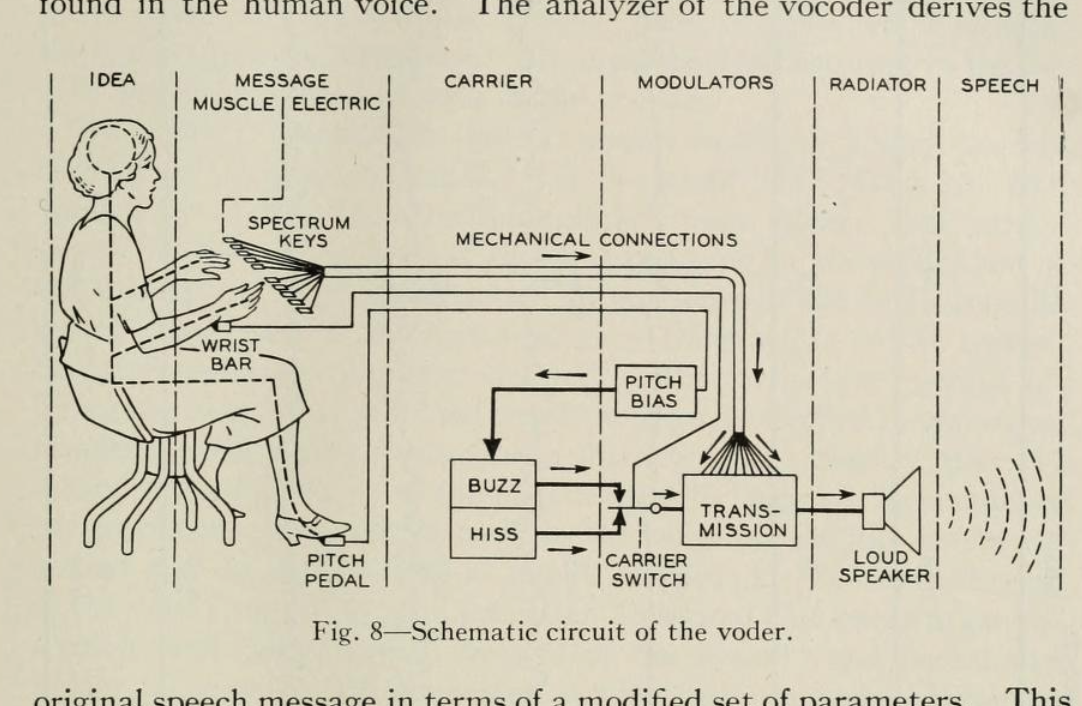
Homer Dudley, The Bell System Technical Journal. Vol. XIX No.4, 1940. pg. 509

INFO 6940 Global History of AI

From the Bible to ChatGPT, how early modern philosophy, modern defense, and today's capitalism birthed the rise of AI.

Since the public release of ChatGPT, "AI" has taken the world by storm encroaching our daily lives, setting the agenda for government policies, changing how we work, and raising questions about the meaning of human intelligence . But how did it all start? Was it really just Google's Transformers? And are we living through a "once-in-a-humanity" moment? 

This course explores how philosophizing, engineering, building, and financing human-made intelligence has evolved over centuries of human history across many continents around the world. While "Artificial Intelligence" as a term has been coined recently the idea of imitating natural intelligence and human behavior has co-existed with the birth of modern science. We will start with the ponderings of natural philosophers of the 16th century Europe, explore the impact of the two industrial revolutions on spread of automation, the world wars, Cold War defense agenda, post-colonial Asia's geopolitical gamble and modern Silicon Valley to tell a full story of how science is born in a complex socio-political context. Students will learn to evaluate and appreciate how modern AI products and systems are the result of human decisions, scientific serendipity, as well as real immediate needs.  
Fridays ET 11:15am ~ 1:45pm
Cornell Tech: Bloomberg 397
Cornell Ithaca: Statler Hall 198
Office hours by appointment: unsojo@cornell.edu
Course Resources
This course was taught at Seoul National University (School of Law) in Fall 2023 and at Cornell University (Information Science, Bowers) Spring 2025 & Spring 2026.

A youtube series with video recordings will be released soon!
A history of AI book & textbook based on this course material will be available on arXiv soon!

Meanwhile, the Book Blog section will be updated summer 2026 with reviews on relevant readings.
Some topics we cover in this course:
  • Cold War and geopolitics of AI
  • Early modern philosophy on human-made intelligence
  • Mid-20th Century Cybernetics and feedback
  • History of language AI and chatbots
  • Games, medicine, and other domain adoption of  AI
  • Internet, data, cloud, and the rise of consumer tech
  • Origins of robots, robotics, humanoids, and automation
  • U.S. defense spending and the industrial-academic-military complex
  • Global hardware and microchips for machine learning
Important Dates

Take-home Midterm: TBD
Final Research Paper Due: TBD


FAQ
1) Is this a super technical course? What are recommended or required prerequisites?
This is a semi-technical or kind-of-technical course. You will reap the most from it if you have a background in basic machine learning, statistics, algorithms, software engineering, and/or computer systems. But you can be successful in this course without such a background. It's worth trying it out and learning materials on your own for more depth.

2) Will this be a lot of reading?
The readings for this course were recommended as of 2026. Starting 2027, we will include a separate required reading list and course notes that will be part of your core course content in addition to the lectures.

3) What are the exams and assignments like?
Until 2026, the assignments were written responses, student presentations, and final research paper. Starting 2027, we will have a mix of problem sets, quizes/midterms, and a final research paper. More information coming soon!